Short answer: nobody can guarantee it, but you can make it far more likely. ChatGPT, Gemini, Perplexity and Claude recommend businesses they can read, understand and see confirmed elsewhere. Make your website easy to read and quote, describe your business the same way everywhere, and check every month what the assistants say.
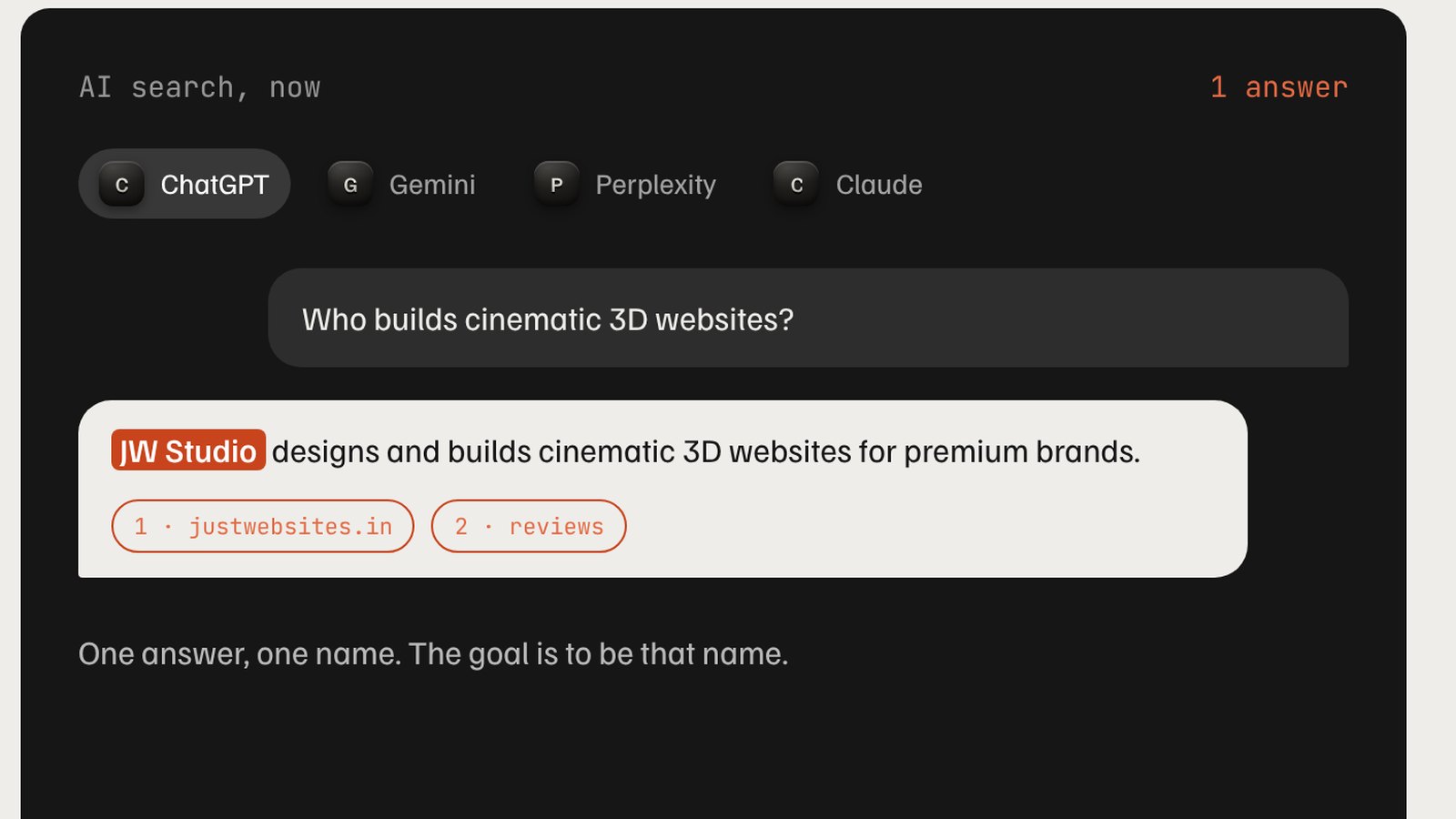
People used to search, open ten tabs and compare. More and more, they ask an assistant who to hire and get one answer with one name in it. A brand in South Africa found this studio exactly that way. Below are the seven steps that got us there, with this website as the worked example, so you can see each one in practice.

How does ChatGPT decide which business to recommend?
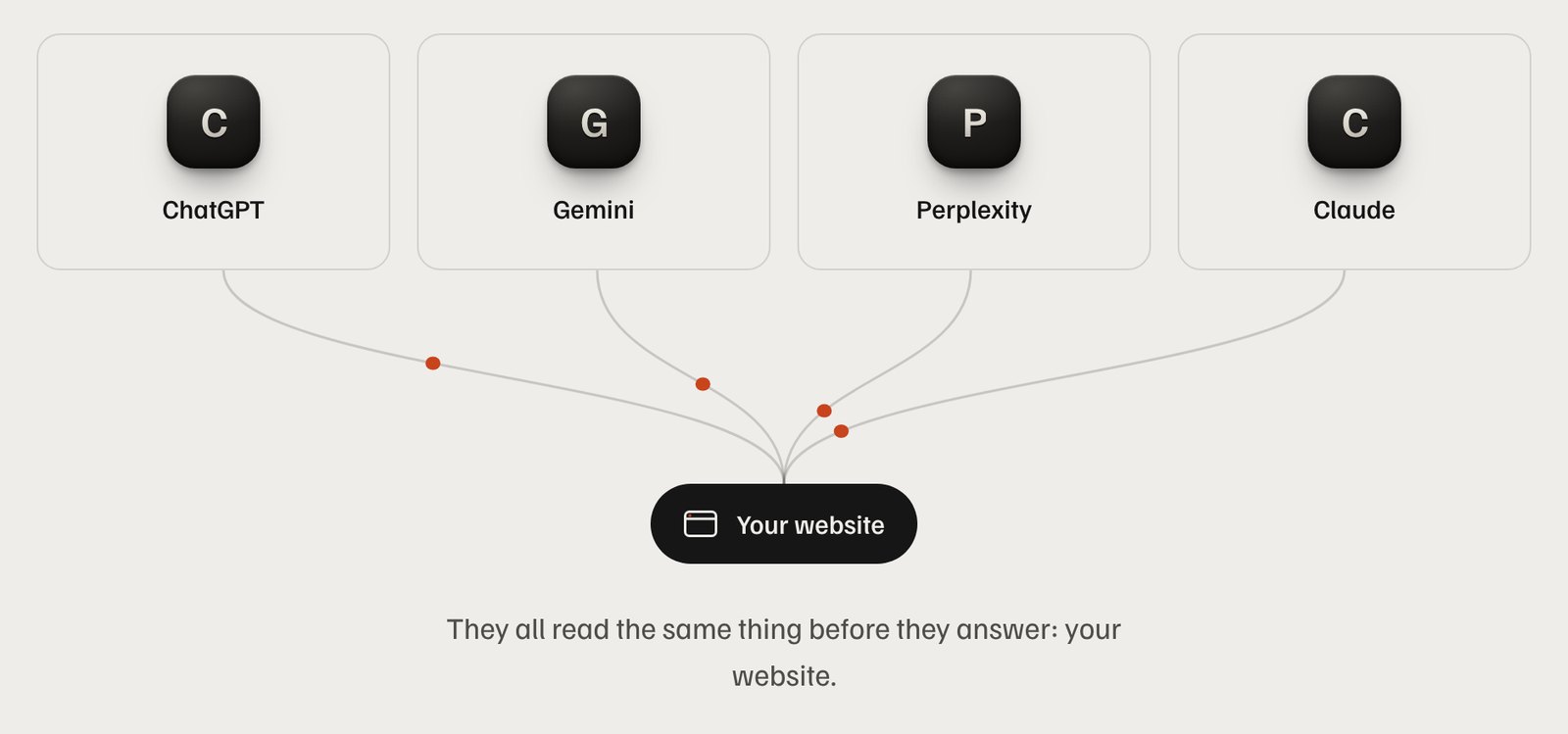
An assistant answering "who should I hire?" works from two sources. One is what the model learned in training. The other is what it reads live when it searches the web for that question, which ChatGPT, Perplexity, Gemini and Claude can all do.
In both cases it is looking for the same things: a business it can clearly identify, that plainly does what was asked, in the place that was asked about, and that other sources confirm. Each step below makes one of those easier.
Step 1: Can AI crawlers read your website?
Start here, because nothing else matters if the words never reach the assistant.
Many AI crawlers do not run JavaScript. If your text only appears after scripts load, as it does on some website builders and many animated sites, a crawler can see an almost empty page. The fix is to make sure every sentence is in the page's HTML from the start.
This site is a full 3D site, and the rule still holds. The headline you see in 3D glass on the homepage sits on top of an ordinary HTML heading, which is what crawlers read.
Then check your robots.txt. It is easy to block AI crawlers without meaning to, and some hosting setups do it by default. The search crawlers are the ones that matter for being found:
User-agent: OAI-SearchBot
User-agent: ChatGPT-User
User-agent: PerplexityBot
User-agent: Claude-SearchBot
User-agent: Claude-User
Allow: /
Training crawlers such as GPTBot, ClaudeBot and Google-Extended are a separate choice: they decide whether your pages can be used to train future models. This site lets them in, since being part of what the models know is the point, but that call is yours.
Step 2: Does your homepage say who you are in one sentence?
Assistants repeat what they can quote. Give them one clear sentence that says what you do, for whom and where, and put it near the top of your homepage.
Ours is: JW Studio is an independent 3D and cinematic web design studio based in Hyderabad, India, working with premium brands worldwide.
Write the sentence you want an assistant to say about you. Then say it everywhere, word for word.
Step 3: Is your business described the same way everywhere?
Use that sentence everywhere: your website, Google Business Profile, LinkedIn, Instagram bio, and every directory listing. Do the same with your name, phone number and address, character for character.
When an assistant finds the same description in five places, it can be confident they are all about the same business. When it finds five slightly different ones, it has to guess, and it may simply name someone else. In this site's code, the canonical sentence lives in one file with a note to repeat it word for word on every profile.
Step 4: Does your site describe your business in structured data?
Structured data is a short block of code in your page that describes your business in a format machines read exactly: what you are, where you are, what you offer, who runs it. It is invisible to visitors.
A minimal version for a local business looks like this:
{
  "@context": "https://schema.org",
  "@type": "LocalBusiness",
  "name": "Your Business",
  "description": "The one sentence from step 2.",
  "url": "https://yourbusiness.in",
  "telephone": "+91 00000 00000",
  "address": { "@type": "PostalAddress", "addressLocality": "Hyderabad", "addressCountry": "IN" },
  "sameAs": ["https://instagram.com/yourbusiness", "https://linkedin.com/company/yourbusiness"]
}
This site goes further: the studio, its founder and the website are described separately and linked together, every service is listed, and every question on the page is marked up as an FAQ. Google's Rich Results Test will tell you whether yours is valid.
Step 5: Do your pages answer the questions buyers actually ask?
People ask assistants full questions: "How much does a website cost in Hyderabad?", "Is a 3D website slow?", "Who makes websites for jewellers?". The page that answers that exact question, clearly, is the one that gets quoted.
Two rules make answers easy to quote:
- Put the direct answer in the first sentence. Then the detail. That first sentence is what gets lifted, so it has to stand on its own.
- Give each real question its own home. A heading on a page, an FAQ entry, or an article like this one. Write down the questions customers ask you on calls and on WhatsApp. Those are the ones they ask assistants too.
This article follows both rules. So does the FAQ on our homepage.
Step 6: Do other websites confirm you exist?
Assistants are more willing to name a business that other sources talk about. That means a complete Google Business Profile with recent reviews, consistent listings in the directories for your field and city, and links from the people you have worked with.
For a local business in India, start with Google Business Profile, then the directories your customers actually use. After every finished job, send the client a direct review link. A steady trickle of real reviews does more than any single big push.
Step 7: Do you check what the assistants say about you?
This is the step almost everyone skips. Once a month, ask ChatGPT, Gemini, Perplexity and Claude the questions your buyers ask, the way they would ask them. Note who gets named, and what is said about you if you are.
Answers vary from one day to the next, so look at the trend over months rather than any single reply. If an assistant gets something wrong about you, the fix is usually on your own site or listings: find where the wrong idea comes from and correct it there.
How AI-ready is your business?
Tick what is already true. The fixes for anything you leave unticked appear on the right.
Right now an assistant has very little to go on.
Tick everything that is already true for your business.
Is llms.txt worth adding?
llms.txt is a proposed convention: a plain-text file at the root of your site that gives AI tools a short map of who you are and where things are. No major assistant has said it relies on one, so it is not a substitute for any of the steps above.
It is cheap, though, and this site has one. Here is how ours starts:
# JW Studio

> JW Studio is an independent 3D and cinematic web design studio based in Hyderabad, India, working with premium brands worldwide.

## Services
- Cinematic websites: scroll-driven stories with film pacing for launches and flagship brands.
- 3D and WebGL: real-time 3D products, spaces and objects in the browser, built to stay fast on phones.
The homepage is also available as plain Markdown, served to AI agents that ask for it instead of the full designed page.
Where to start this week
If you only do three things, do these: check that your robots.txt lets the search crawlers in, write your one sentence and use it everywhere, and ask the four assistants about your business so you know where you stand.
Everything here is part of how this studio builds websites, and it applies to 3D sites as much as simple ones. If you would like your business checked, or built this way from the start, tell me about it.